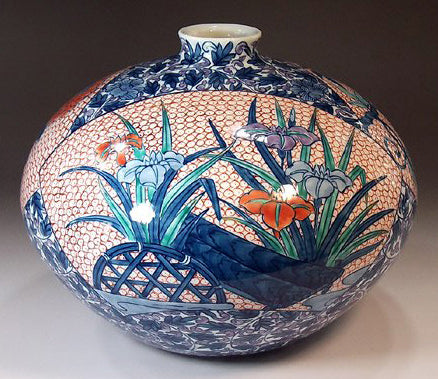
Fujii Kinsai Arita Japan - Somenishiki Karakusa Ougimen flower Vase 14.50 cm 染錦唐草扇面花絵飾り花瓶 - Free Shipping
Product Name
Fujii Kinsai Arita Japan - Somenishiki Karakusa Ougimen flower Vase 14.50 cm
( Wisteria, Iris, Peony. )
染錦唐草扇面花絵飾り花瓶
Limited edition piece; includes a bookmark detailing the artist's ceramic career.
Signed by the artist. Comes in a wooden box.
All of our products are all handmade and hand painted by Master Fujii Kinsai,
therefore each individual item are slightly different each other.
*Somenishiki* is a traditional Arita ware style characterized by the incorporation of colors such as red, green, blue, and yellow. The process involves applying underglaze blue decoration and firing the piece at 1,300°C, followed by painting with traditional Arita overglaze enamels and firing again at 800°C. Because each color requires a separate firing, a single piece may undergo between four and ten firings before completion. Originating around 1675, *Somenishiki* (specifically the *Iro-Nabeshima* style) was initially created for castle furnishings and as presentation gifts for the Shogunate, feudal lords, and the Imperial Court; these techniques and traditions are still preserved today.
**Peony (*Botan*)**
With its magnificent, large blossoms and noble bearing, the peony has long been known in China as the "King of Flowers" and a symbol of wealth and honor. In Japan, too, the stunning beauty of the peony has inspired designs across a wide range of art forms, including paintings and crafts. It is an auspicious motif that conveys a sense of elegant gentleness amidst its splendor.
**Wisteria (*Fuji*)**
Wisteria is a tree that grows wild in the mountains and fields, producing beautiful blossoms. It frequently appears in classical literature and influenced Japanese culture; notably, the Fujiwara clan adopted the name and the wisteria flower as their family crest during the Heian period. Its graceful appearance has long been admired, making it a very common motif in Arita and Imari ware. The elegant and refined wisteria remains a highly popular design today.
**Iris (*Shobu* / *Ayame*)**
The iris is considered an auspicious plant; its flat, sword-like leaves resemble a samurai's blade, and its remarkably refreshing fragrance is believed to ward off evil spirits. Furthermore, the Japanese pronunciation of the plant's name (*shobu*) is a homophone for words signifying competitive strength and the martial spirit (*shobu*), making it a symbol of victory and propriety. Prized since ancient times for their elegant appearance, irises have frequently been depicted on Iro-Nabeshima and Ko-Imari wares. With their grace and refinement, irises remain a highly popular motif to this day.
**Folding Fans (*Sensu*)**
Folding fans are considered auspicious because they spread out into a fan shape, symbolizing "ever-widening prosperity" (*suehirogari*). In Arita ware, they often appear as fan-shaped "window" panels framing images of flowers or birds. This elegant design is a traditional auspicious motif that embodies the wish for enduring happiness.
**Arabesque (*Karakusa*)**
The arabesque pattern depicts the intertwining vines of a plant. Arita ware features a wide variety of arabesque designs, such as those combining vines with flowers, leaves, or fruit—including chrysanthemum, peony, and paulownia arabesques—as well as the "octopus arabesque" (*tako-karakusa*), named for patterns resembling the suction cups on an octopus's tentacles. Admired by all for its perfected beauty as a traditional design, the arabesque motif appears frequently on Arita and Imari wares. Because the vines extend endlessly in all directions without interruption, it is regarded as a traditional auspicious motif symbolizing longevity and prosperity.
Condition
Limited Edition Products by Master Fujii Kinsai Arita Saga Japan.
The number of each production are very limited
and we sell only AAA+ (Finest quality item only).
Vase Size
Height 14.50 cm (5.709 ")
Diameter 17.40 cm (6.850 ")
Delivery Time
We will ship your order within 10 days.


We Also Recommend