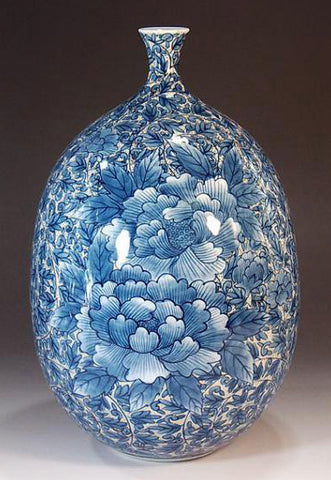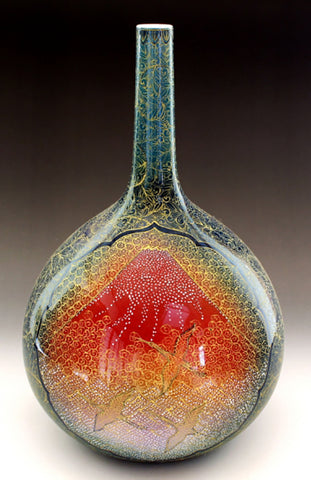


Fujii Kinsai Arita Japan - Koimari Style Peony Karakusa Wari Hanakago Agarwood Pot 33.00 cm 古伊万里様式牡丹唐草割花篭絵飾り沈香壺 - Free Shipping
Product Name
Fujii Kinsai Arita Japam - Koimari Style Kinrande Hanakago Agarwood Pot 33.00 cm
古伊万里様式牡丹唐草割花篭絵飾り沈香壺
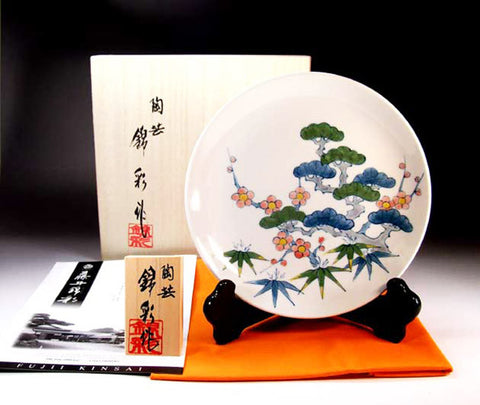
Limited edition piece; includes a bookmark detailing the artist's ceramic career.
Signed by the artist. Comes in a wooden box.
All of our products are all handmade and hand painted by Master Fujii Kinsai,
therefore each individual item are slightly different each other.
Old Imari Style
Ceramics fired in the Hizen region (modern-day Saga and Nagasaki prefectures) from the late 17th to the late 18th century were exported to European nations via the port of Imari. Consequently, these ceramics came to be known both domestically and internationally as "Imari ware" (or "Old Imari") after the port's name. Characterized by deep blue underglaze and the lavish use of red and gold pigments—with floral patterns often covering the entire surface—this style is thought to reflect the prosperous spirit of the Genroku era. Hizen ceramics exported to Europe were prized possessions, displayed in royal palaces and aristocratic mansions. The elegant, magnificent style that captivated 17th-century Europe remains beloved today and lives on as a signature style of Arita ware.
Jinkō-tsubo (Agarwood Jar)
These jars were designed to hold aromatic wood; while the lid was kept closed during daily use, it would be opened when guests arrived, allowing the fragrant scent to fill the room and welcome visitors. Produced in the Hizen region (Saga and Nagasaki prefectures) between the late 17th and late 18th centuries, these jars were exported to Europe through the port of Imari. As a result, the porcelain became known as "Imari ware" (or "Old Imari") both at home and abroad. Once in Europe, these jars were highly valued and displayed in the palaces of royalty and the homes of the aristocracy. The elegant, magnificent style that captivated 17th-century Europe continues to be cherished today, adding a touch of splendor and luxury to interiors.
Peony (Botan)
With its magnificent, large blossoms and noble bearing, the peony has long been known in China as the "King of Flowers" and revered as a symbol of wealth and honor. In Japan, the peony is prized for its magnificent, full bloom, and its design is frequently incorporated into a wide array of paintings and crafts. It is considered an auspicious motif that conveys a sense of elegant gentleness amidst its splendor.
Cherry Blossoms (Sakura)
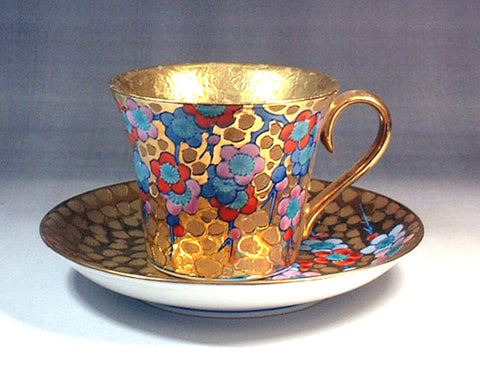
Cherry blossoms are so beloved that they are synonymous with Japanese flowers and serve as the country's national flower. Their exquisite appearance has long inspired their use in diverse artistic forms, including paintings and traditional crafts. Whether in glorious full bloom or shedding petals that flutter gently to the ground, the cherry blossom is a highly popular motif that evokes a festive and radiant atmosphere.
Karakusa (Arabesque)
The *karakusa* (arabesque) pattern depicts the intertwining vines of a plant. Arita ware features a wide variety of these designs, ranging from patterns combining vines with flowers, leaves, or fruit—such as chrysanthemum, peony, or paulownia arabesques—to the "octopus arabesque" (*tako-karakusa*), named for its resemblance to the suction cups on an octopus's tentacles. As a perfected traditional design, it is universally admired and frequently appears on Arita and Imari ware. Because the arabesque pattern extends endlessly in all directions without interruption, it is regarded as an auspicious motif symbolizing longevity and prosperity.
Plate Size
Height 33.00 cm (12.992 ")
Diameter 13.50 cm (5.315 ")
Delivery Time
We will ship your order within 10days.


We Also Recommend