

Fujii Kinsai Arita Japan - Somenishiki Kinsai Hyoutan wari Tessen Vase 35.00 cm 染錦金彩瓢箪割鉄線花絵飾り花瓶 - Free Shipping
Product Name
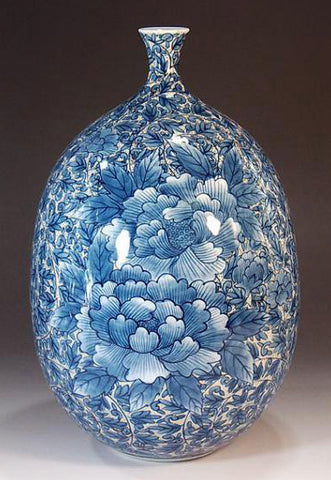
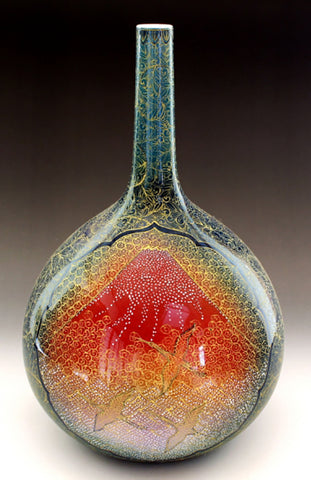
Fujii Kinsai Arita Japan - Somenishiki Kinsai Hyoutan wari Tessen Vase 35.00 cm
染錦金彩瓢箪割鉄線花絵飾り花瓶
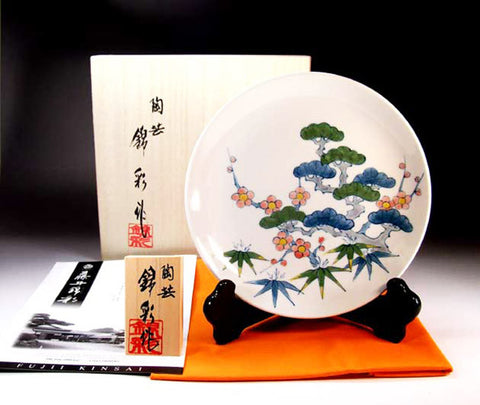
Limited edition piece; includes a bookmark detailing the artist's ceramic career.
Signed by the artist. Comes in a wooden box.
All of our products are all handmade and hand painted by Master Fujii Kinsai,
therefore each individual item are slightly different each other.
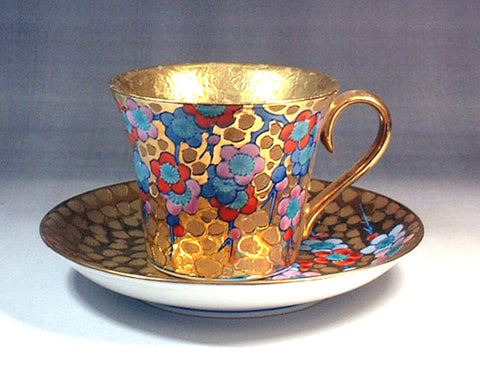
*Kinsai* (gold decoration) is a traditional Arita ware style characterized by a multi-stage firing process. It begins with underglaze blue painting followed by glazing and firing at 1,300°C; next, traditional Arita overglaze enamels (red, green, blue, yellow, etc.) are applied and fired at 800°C; finally, gold is used to add decorative patterns. Because the piece is fired after the application of each color, the creation of a single work involves five to ten separate firings. The result is a magnificent, dignified style that combines brilliant gold decoration with inventive color schemes and layouts.
**Iro-Nabeshima (Colored Nabeshima) Style**
Wares intended as gifts or for personal use by the Nabeshima family of Saga were produced in the domain's official kiln. Pieces from this kiln are known as "Nabeshima ware" and are highly acclaimed worldwide. As they were commissioned as gifts, the products were crafted to a high standard of perfection and elegance. The official kiln is believed to have been established at Iwataya-gawachi (Arita) during the Kan'ei era (1624–1644), moved to Minami-gawara (Arita) during the Kanbun era (1661–1673), and finally relocated to Okawachi (Imari City) during the Enpō era (1673–1680). While "Nabeshima" ware includes celadon and underglaze blue pieces, those featuring overglaze enamel colors are specifically known as "Iro-Nabeshima" (Colored Nabeshima). The decoration of Iro-Nabeshima is based on four colors: the blue of the underglaze and the red, green, and yellow of the overglaze enamels. The Nabeshima style lives on today as a decorative technique in modern Arita ware.
**Gourds (*Hyōtan*)**
The image of six gourds (*mu-byō*) is associated with the Japanese word for "good health" or "freedom from illness" (*mubyō*), as the pronunciations are identical. There is also a proverb, "a horse from a gourd" (*hyōtan kara koma*), which refers to an unexpected event where something said in jest actually comes true. The gourd is widely cherished for its unique, distinctive shape—featuring a characteristic constriction—and its auspicious nature; consequently, it frequently appears as a motif in Arita and Imari ware. It is a traditional, lucky pattern symbolizing good health, longevity, and family harmony.
Tessen (Clematis)
The name *tessen* (literally "iron wire") refers to the plant's vines, which are as strong as iron wire. Long admired for its graceful appearance, the clematis has frequently been depicted in Arita and Imari ware. With its charming aesthetic, it remains a highly popular pattern to this day.
Condition
Limited Edition Products by Master Fujii Kinsai Arita Saga Japan.
The number of each production are very limited
and we sell only AAA+ (Finest quality item only).
Vase Size
Height 35.00 cm (13.779 ")
Diameter 30.80 cm (12.126 ")
Delivery Time
We will ship your order within 10days.


We Also Recommend