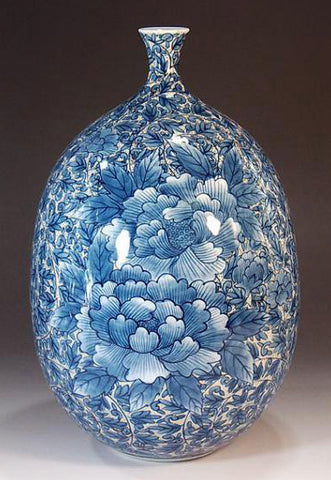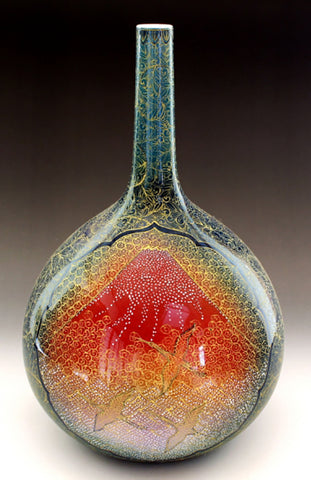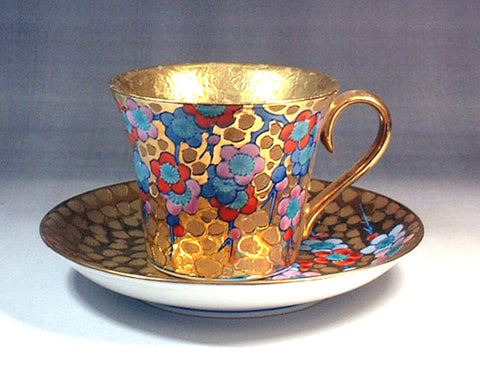


Fujii Kinsai Arita Japan - Somenishiki Karakusa Batanwari Quail Agarwood Pot 28.50 cm 染錦唐草牡丹割鶉雀絵飾り沈香壺 - Free Shipping
Product Name
Fujii Kinsai Arita Japam - Somenishiki Karakusa Batanwari Quail
Agarwood Pot 28.50 cm
(Sparrow, Quail, Peony, Botankarakusa Monyou.)
染錦唐草牡丹割鶉雀絵飾り沈香壺
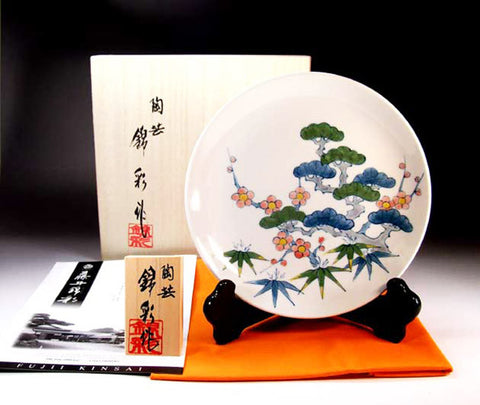
Limited edition piece; includes a bookmark detailing the artist's ceramic career.
Signed by the artist. Comes in a wooden box.
All of our products are all handmade and hand painted by Master Fujii Kinsai,
therefore each individual item are slightly different each other.
*Somenishiki* (literally "dyed and brocaded") is a traditional style of Arita and Imari ware. The process begins with underglaze blue painting followed by glazing and firing at 1,300°C; subsequently, traditional Arita-style colored enamels are applied, and the piece is fired again at 800°C to incorporate colors such as red, green, blue, and yellow. Because the piece is fired once for each color applied, the creation of a single work involves between four and ten separate firings. The *Somenishiki* style (including *Iro-Nabeshima*) originated around 1675; these pieces were initially crafted as furnishings for castles and as presentation gifts for the Shogunate, feudal lords, and the Imperial Court. These techniques and traditions continue to be passed down to the present day.
*Jinkō-tsubo* (Agarwood Jar)
These jars were designed to hold aromatic wood (*jinkō* or agarwood). While the lid was kept closed during daily use, it would be opened when guests arrived, allowing the fragrant scent to drift through the room and welcome the visitors. Produced in the Hizen region (modern-day Saga and Nagasaki prefectures) between the late 17th and late 18th centuries, these jars were exported to Europe via the port of Imari. Consequently, porcelain from the Hizen region came to be known both domestically and internationally as "Imari ware" (or "Old Imari"), named after the port from which it was shipped. The jars that reached Europe were prized possessions, displayed in royal palaces and aristocratic mansions. The graceful, magnificent style that captivated 17th-century Europe remains beloved today, adding a touch of splendor and opulence to interiors.
Quail (*Uzura*)
The quail is a bird of the pheasant family characterized by a round body, a short tail, and reddish-brown plumage speckled with black, yellow, and white; it is known for migrating long distances. Long a popular subject in crafts and paintings, the quail is cherished as a motif that evokes a sense of loveliness, warmth, and tranquility. Because the bird's call sounds like the Japanese phrase *go-kitchō* (meaning "an auspicious omen"), it is regarded as a highly lucky, auspicious design. Sparrow (*Suzume*)
The sparrow is a highly familiar bird that has long been regarded as a symbol of abundance. Frequently featured in crafts and paintings since ancient times, it creates an adorable, heartwarming, and gentle pattern. Sparrows are considered auspicious birds that invite good fortune; they are believed to peck away at misfortune and evil, while also symbolizing a bountiful harvest. This pattern embodies wishes for family prosperity and safety, evoking a sense of warmth and familiarity.
Peony (*Botan*)
With its magnificent, large blossoms and noble bearing, the peony has long been known in China as the "King of Flowers" and a symbol of wealth and honor. In Japan, too, the stunning beauty of the peony has inspired its use in a wide variety of designs, from paintings to traditional crafts. It is an auspicious pattern that conveys an elegant gentleness amidst its splendor.
Arabesque (*Karakusa*)
The *karakusa* (arabesque) pattern depicts the intertwining vines of a plant. In Arita ware, there is a diverse range of these patterns, including combinations of vines with flowers, leaves, or fruits—such as chrysanthemum, peony, and paulownia arabesques—as well as the "octopus arabesque" (*tako-karakusa*), named for its resemblance to the suction cups on an octopus's tentacles. Admired by all for its perfected beauty as a traditional design, it appears frequently on Arita and Imari ware. Because the vines extend endlessly in all directions without interruption, the arabesque is a traditional auspicious pattern symbolizing longevity and prosperity.
Plate Size
Height 28.50 cm (11.220 ")
Diameter 16.50 cm (6.496 ")
Delivery Time
We will ship your order within 10days.


We Also Recommend