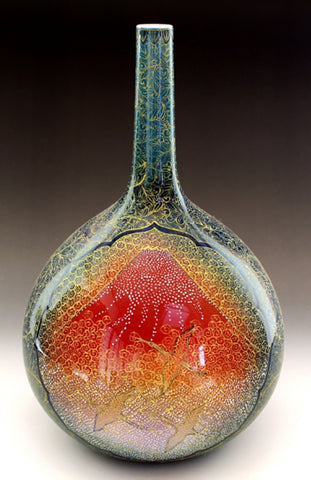


Fujii Kinsai Arita Japan - Somenishiki karakusa dobutsu keizu Vase 21.00 cm 染錦唐草動物景図飾り花瓶 - Free Shipping
Product Name
Fujii Kinsai Arita Japan - Somenishiki karakusa dobutsu keizu Vase 21.00 cm
染錦唐草動物景図飾り花瓶
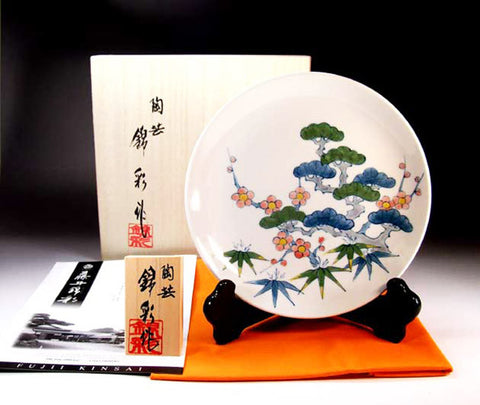
Limited edition piece; includes a bookmark detailing the artist's ceramic career.
Signed by the artist. Comes in a wooden box.
All of our products are all handmade and hand painted by Master Fujii Kinsai,
therefore each individual item are slightly different each other.
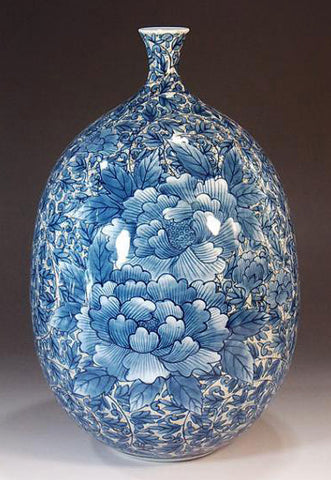
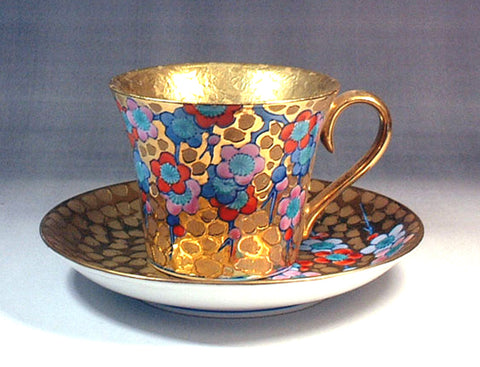
*Somenishiki* (or *Iro-Nabeshima*) is a traditional Arita ware style characterized by a multi-step process: underglaze blue patterns are applied and fired at 1,300°C, followed by the application of traditional colored enamels and a second firing at 800°C to incorporate hues such as red, green, blue, and yellow. Because each color requires a separate firing, a single piece may undergo between four and ten firings before completion. Originating around 1675, this style was initially created for castle furnishings and as tribute gifts for the Shogunate, feudal lords, and the Imperial Court; these techniques and traditions are preserved to this day.
**Carp**
In China, the carp is revered as a symbol of great strides and career advancement, based on the legend that a carp ascending the "Dragon Gate" waterfall in the Yellow River's rapids transforms into a dragon. This concept spread to Japan, and by the late Edo period, the custom of flying *koinobori* (carp streamers) during the Tango no Sekku festival emerged, expressing wishes for children's healthy growth and future success. Carp motifs have long been cherished across various art forms, including *makie* lacquerware and ceramics. With their noble beauty, carp are considered highly auspicious and popular decorative motifs.
**Monkey**
Monkeys are regarded as mystical beings in China. Because their movements and appearance resemble those of humans, they frequently appear as protagonists in folktales and legends, such as *Journey to the West*. In Japan, too, monkeys have long been believed to be messengers of the gods. Due to the pun between the word for monkey (*saru*) and the verb "to leave" or "drive away" (*saru*), the monkey serves as an auspicious motif symbolizing the removal of misfortune and the achievement of promotion or success.
**Deer**
Deer are familiar animals in Japan, frequently appearing in ancient poetry such as the *Man'yōshū*. In China, the word for deer is pronounced *roku*; because this sounds similar to the word for "official salary" or "prosperity" (*roku*), the deer is associated with *fukuroku* (good fortune and prosperity) and is said to bring such blessings. Influenced by these origins, this design has long been cherished in Japan as an auspicious pattern symbolizing longevity and prosperity, appearing on a wide variety of items ranging from decorative objects to furnishings.
Karakusa (Arabesque)
The *karakusa* (arabesque) pattern depicts the intertwining vines of a plant. In Arita ware, this motif takes on many forms; examples include *kiku-karakusa* (chrysanthemum arabesque), *botan-karakusa* (peony arabesque), and *kiri-karakusa* (paulownia arabesque)—which combine vines with flowers, leaves, or fruit—as well as the *tako-karakusa* (octopus arabesque) pattern, so named because the swirling vine motifs resemble the suction cups on an octopus's tentacles. Admired by all for its perfected beauty as a traditional design, it frequently adorns Arita and Imari ware. Because the arabesque vines extend endlessly in all directions without interruption, the pattern is considered a traditional auspicious symbol representing longevity and prosperity.
Condition
Limited Edition Products by Master Fujii Kinsai Arita Saga Japan.
The number of each production are very limited
and we sell only AAA+ (Finest quality item only).
Vase Size
Height 21.00 cm (8.267 ")
Diameter 22.10 cm (8.700 ")
Delivery Time
We will ship your order within 10 days.


We Also Recommend