Product Name
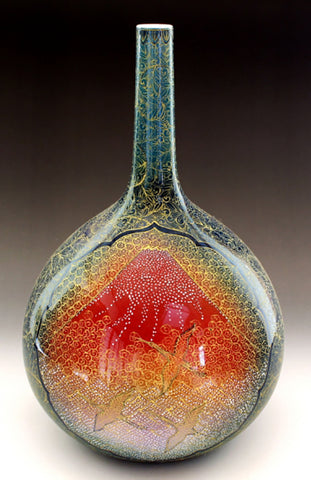
Fujii Kinsai Arita Japan - Somenishiki Kinsai Chrysanthemum, Karakusa Wari Vase 30.30 cm
(Chrysanthemum, Karakusa, Pine, Bamboo, Plum, Birds)
染錦金彩菊唐草割景図一輪挿し
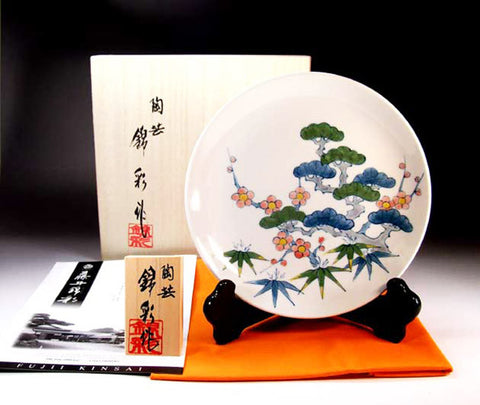
Limited edition piece; includes a bookmark detailing the artist's ceramic career.
Signed by the artist. Comes in a wooden box.
All of our products are all handmade and hand painted by Master Fujii Kinsai,
therefore each individual item are slightly different each other.
*Kinsai* (gold decoration) is a traditional Arita ware style characterized by a multi-stage process: underglaze painting followed by glazing and firing at 1,300°C; overglaze painting using traditional Arita pigments (red, green, blue, yellow, etc.) followed by firing at 800°C; and finally, the application of gold patterns for decoration. Because the piece is fired after the application of each color, the creation of a single work involves five to ten separate firings. It is a magnificent and dignified style that incorporates brilliant gold decoration alongside inventive color schemes and layouts.
**Chrysanthemum (*Kiku*)**
The chrysanthemum serves as the emblem of the Imperial Family. Renowned for its exquisite shape, color, and fragrance, it frequently appears in Old Imari and Iro-Nabeshima (colored Nabeshima) wares. Along with the orchid, plum blossom, and bamboo, it is one of the "Four Gentlemen" (*Shikunshi*)—an auspicious motif deeply cherished in art and culture.
**Pine, Bamboo, and Plum (*Sho-chiku-bai*)**
The pine and bamboo—which retain their greenery even amidst wind, snow, and bitter cold—and the plum blossom—which blooms earlier than other plants—are revered as symbols of longevity, nobility, and purity. The pine represents enduring vitality; the bamboo signifies steadfast integrity and nobility; and the plum is celebrated for its pure fragrance and elegance. These designs have long adorned a wide variety of objects, including ceramics; as a gorgeous motif suitable for celebrations, they are regarded as auspicious symbols of good fortune.
**Arabesque (*Karakusa*)**
The *karakusa* (arabesque) pattern depicts the intertwining vines of a plant. Arita ware features a diverse array of these patterns, such as *kiku-karakusa* (chrysanthemum arabesque), *botan-karakusa* (peony arabesque), and *kiri-karakusa* (paulownia arabesque), which combine vines with flowers, leaves, or fruits. Another notable variety is *tako-karakusa* (octopus arabesque), named for the resemblance of its swirling patterns to the suction cups on an octopus's tentacles. Appreciated by all for its perfected beauty as a traditional design, the arabesque motif frequently appears on Arita and Imari ware. The *karakusa* (arabesque) pattern is a traditional auspicious design; because the vines extend endlessly in all directions, it is said to symbolize longevity and prosperity.
Condition
Limited Edition Products by Master Fujii Kinsai Arita Saga Japan.
The number of each production are very limited
and we sell only AAA+ (Finest quality item only).
Material
Using real Gold
Vase Size
Height 30.30 cm (11.929 ")
Diameter 11.50 cm (4.528 ")
Delivery Time
We will ship your order within 10 days.