

Fujii Kinsai Arita Japan - Somenishiki Kinsai Yurikou Shobu(Iris) Ornamental plate 33.30 cm 染錦金彩釉裏紅菖蒲絵飾り大皿(径33.3cm) - Free Shipping
Product Name
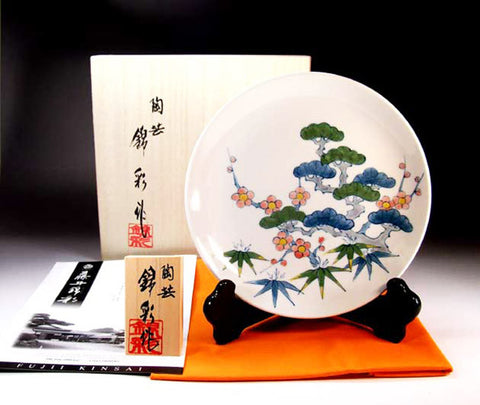
Fujii Kinsai Arita Japan - Somenishiki Kinsai Yurikou Shobu(Iris)
Ornamental plate 33.30 cm
染錦金彩釉裏紅菖蒲絵飾り大皿(径33.3cm)
Limited edition piece; includes a bookmark detailing the artist's ceramic career.
Signed by the artist. Comes in a wooden box.
All of our products are all handmade and hand painted by Master Fujii Kinsai,
therefore each individual item are slightly different each other.
*Kinsai* (gold decoration) is a traditional Arita ware style characterized by a multi-stage process: first, underglaze blue painting is applied and fired at 1,300°C; next, traditional Arita overglaze enamels (red, green, blue, yellow, etc.) are painted on and fired at 800°C; finally, gold is used to add decorative patterns. Because the piece is fired once for each color applied, a single finished work may undergo five to ten separate firings. The result is a magnificent, dignified style that combines brilliant gold accents with inventive color schemes and layouts.
*Yūrikō* (underglaze red) is a technique that uses copper-based pigments for underglaze painting; by utilizing oxidation-reduction reactions during firing, a crimson hue is produced beneath a transparent glaze. While the origins of *yūrikō* date back to the late Yuan Dynasty in China (14th century), in the realm of Hizen porcelain, it was produced during the Early Imari period (1610–1650). However, the technique subsequently fell into decline due to the difficulty of the firing process and the instability of the resulting colors. If the firing temperature rises too high, the color fails to develop, leaving the piece stark white; conversely, firing in an oxidizing atmosphere turns the color green. The outcome is highly sensitive to the nature of the flames, and even slight temperature variations can produce completely different colors. Achieving consistent results is extremely difficult—so much so that there have been countless instances where more than two-thirds of the pieces had to be discarded upon removal from the kiln.
Irises (*Shōbu* / *Ayame*)
The iris is considered an auspicious plant; its flat, sword-like leaves evoke the image of a blade, and its remarkably refreshing fragrance is believed to ward off evil spirits. Furthermore, the Japanese pronunciation of the plant's name, *shōbu*, is a homophone for words signifying competitive strength and the martial spirit (*shōbu*—valuing the martial arts and propriety). Prized since ancient times for their elegant appearance, irises have frequently been depicted in Color Nabeshima and Old Imari wares. The graceful and elegant iris remains a highly popular motif even today.
Condition
Limited Edition Products by Master Fujii Kinsai Arita Saga Japan.
The number of each production are very limited
and we sell only AAA+ (Finest quality item only).
Plate Size
Diameter 33.30 cm (13.110 ")
Delivery Time
We will ship your order within 10days.


We Also Recommend