

Fujii Kinsai Arita Japan - Somenishiki Phoenix Karakusa Kiri Vase 19.70 cm 染錦金彩鳳凰唐草桐絵飾り花瓶 - Free Shipping
Product Name
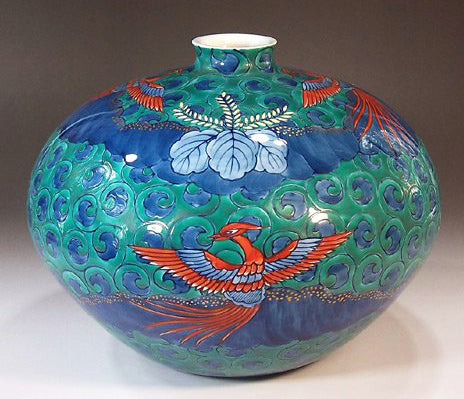
Fujii Kinsai Arita Japan - Somenishiki Phoenix Karakusa Kiri Vase 19.70 cm
(Phoenix, Kiri, Karakusa)
染錦金彩鳳凰唐草桐絵飾り花瓶
Limited edition piece; includes a bookmark detailing the artist's ceramic career.
Signed by the artist. Comes in a wooden box.
All of our products are all handmade and hand painted by Master Fujii Kinsai,
therefore each individual item are slightly different each other.
*Kinsai* (gold decoration) is a traditional Arita ware style characterized by a multi-stage process: underglaze blue painting followed by glazing and firing at 1,300°C; overglaze painting using traditional Arita colors (such as red, green, blue, and yellow) followed by firing at 800°C; and finally, the application of gold patterns for decoration. Because the piece is fired after the application of each color, the creation of a single work involves five to ten separate firings. It is a magnificent and dignified style that incorporates brilliant gold decoration alongside inventive color schemes and layouts.
**Iro-Nabeshima (Colored Nabeshima) Style**
Wares produced for the Saga Nabeshima family—whether for personal use or as gifts—were crafted in the domain's official kilns. Pieces from these kilns are known simply as "Nabeshima" and are highly acclaimed worldwide. As they were intended as gifts, the resulting products were of exceptional quality and elegance. The official kiln is believed to have been established at Iwataya-gawachi (Arita) during the Kan'ei era (1624–1644), moved to Minami-gawara (Arita) during the Kanbun era (1661–1673), and finally relocated to Okawachi (Imari City) during the Enpo era (1673–1680). While "Nabeshima" ware includes celadon and underglaze blue pieces, those featuring overglaze enamel colors are specifically known as "Iro-Nabeshima" (Colored Nabeshima). The decoration of Iro-Nabeshima is based on four colors: the blue of the underglaze and the red, green, and yellow of the overglaze enamels. The Nabeshima style lives on today as a decorative technique in modern Arita ware.
**Phoenix (*Hōō*)**
The phoenix (*hōō*) is a legendary, auspicious bird—known as the "King of Birds"—that, along with the tortoise, *qilin*, and dragon, is counted among the "Four Auspicious Creatures" in ancient Chinese tradition. The legend of the phoenix was introduced to Japan during the Asuka period; its motif has since been used on a wide variety of decorative objects and furnishings, and it remains a beloved, auspicious pattern believed to bring good fortune. Paulownia (Kiri)
Since ancient times, the paulownia has been regarded as an auspicious tree. Considered a noble species, it serves—alongside the chrysanthemum—as an emblem of the Imperial Family. In the decorative motifs of Arita and Imari ware, the paulownia is often paired with the phoenix (ho-o), as legend holds that the mythical bird perches upon this tree; this combination creates a design of great elegance and distinction.
Arabesque (Karakusa)
The arabesque pattern depicts the intertwining vines of a plant. Arita ware features a wide variety of these patterns, ranging from designs combining vines with flowers, leaves, or fruit—such as chrysanthemum, peony, or paulownia arabesques—to the "octopus arabesque" (*tako-karakusa*), named for its resemblance to the suction cups on an octopus's tentacles. Admired by all for its perfected beauty as a traditional motif, the arabesque appears frequently on Arita and Imari ware. Because the vines extend endlessly in all directions without interruption, the pattern is considered an auspicious symbol representing longevity and prosperity.
Condition
Limited Edition Products by Master Fujii Kinsai Arita Saga Japan.
The number of each production are very limited
and we sell only AAA+ (Finest quality item only).
Vase Size
Height 19.70 cm (7.755 ")
Diameter 25.40 cm (10.00 ")
Delivery Time
We will ship your order within 10 days.


We Also Recommend