Fujii Kinsai Arita Japan - Sometsuke Seigaiha Heron & Iris Vase 35.00 cm 染付青海波菖蒲鷺絵飾り花瓶 - Free Shipping
Product Name
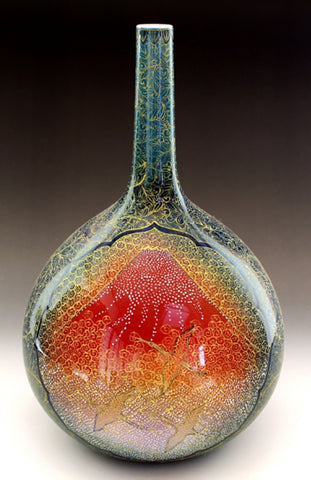
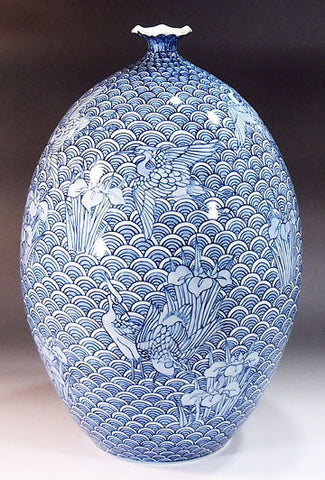
Fujii Kinsai Arita - Sometsuke Seigaiha Heron & Iris Vase 35.00 cm
(Heron, Iris, Seigaiha)
染付青海波菖蒲鷺絵飾り花瓶
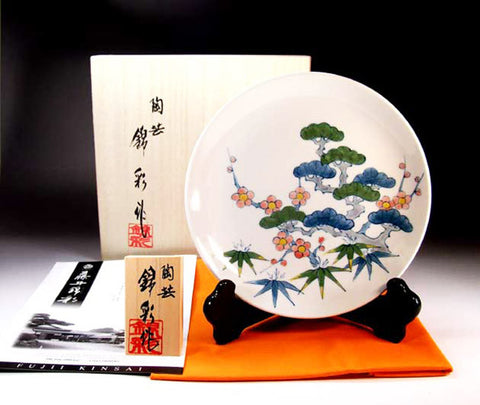
Limited edition piece; includes a bookmark detailing the artist's ceramic career.
Signed by the artist. Comes in a wooden box.
All of our products are all handmade and hand painted by Master Fujii Kinsai,
therefore each individual item are slightly different each other.
*Sometsuke* refers to ware decorated with patterns in a single blue color. This style originated in Arita ware 400 years ago. A design is painted onto the unglazed porcelain body using a pigment known as *gosu*—composed of materials such as cobalt oxide, manganese, iron, and kaolin—and then covered with a transparent glaze before firing, which causes the design to turn blue. The shade of blue varies depending on the amount of cobalt oxide used, the glaze, the porcelain clay, and the firing method; the resulting colors range from vivid indigo to pale hues or deep, dark tones. Appreciating these subtle variations and the unique character of the color is one of the true pleasures of *sometsuke*. Introduced to Arita via China and Korea, the style is characterized by its elegance and beauty, combining the warmth of white porcelain with single-color blue painting.
**Egret (*Sagi*)**
Because egrets fly to watersides near human settlements more frequently than cranes do, they have long been familiar to people and revered as sacred birds. In China, the word for egret (*lu*) is a homophone for the word for "path" or "road" (*lu*), leading to an association with the auspicious phrase "a path to lifelong prosperity." Influenced by this, the motif has been widely adopted in Japan across various media, including *maki-e* lacquerware and ceramics. The image of an egret standing quietly—exuding an air of noble purity—is a popular auspicious design.
**Iris (*Shōbu* / *Ayame*)**
The iris is considered an auspicious plant; its flat, sword-like leaves and refreshing fragrance are believed to ward off evil spirits. Furthermore, the Japanese pronunciation of the plant's name (*shōbu*) is a homophone for words signifying competitive strength and the martial spirit (*shōbu*). Prized since ancient times for its graceful appearance, the iris has frequently been depicted in styles such as Iro-Nabeshima and Ko-Imari. Its elegant and refined form remains a highly popular motif today.
**Seigaiha (Blue Ocean Waves)**
This is a geometric pattern consisting of wave motifs drawn in a fan-like shape and layered in an alternating arrangement. Appreciated by all for its perfected beauty as a traditional design, this motif frequently appears on Iro-Nabeshima and Ko-Imari ware. It is an auspicious pattern embodying the wish for a peaceful life to endure forever—much like the ceaseless, rolling waves of the vast, open ocean.
Condition
Limited Edition Products by Master Fujii Kinsai Arita Saga Japan.
The number of each production are very limited
and we sell only AAA+ (Finest quality item only).
Vase Size
Height 35.00 cm (13.779 ")
Diameter 23.20 cm (19.134 ")
Delivery Time
We will ship your order within 10days.


We Also Recommend